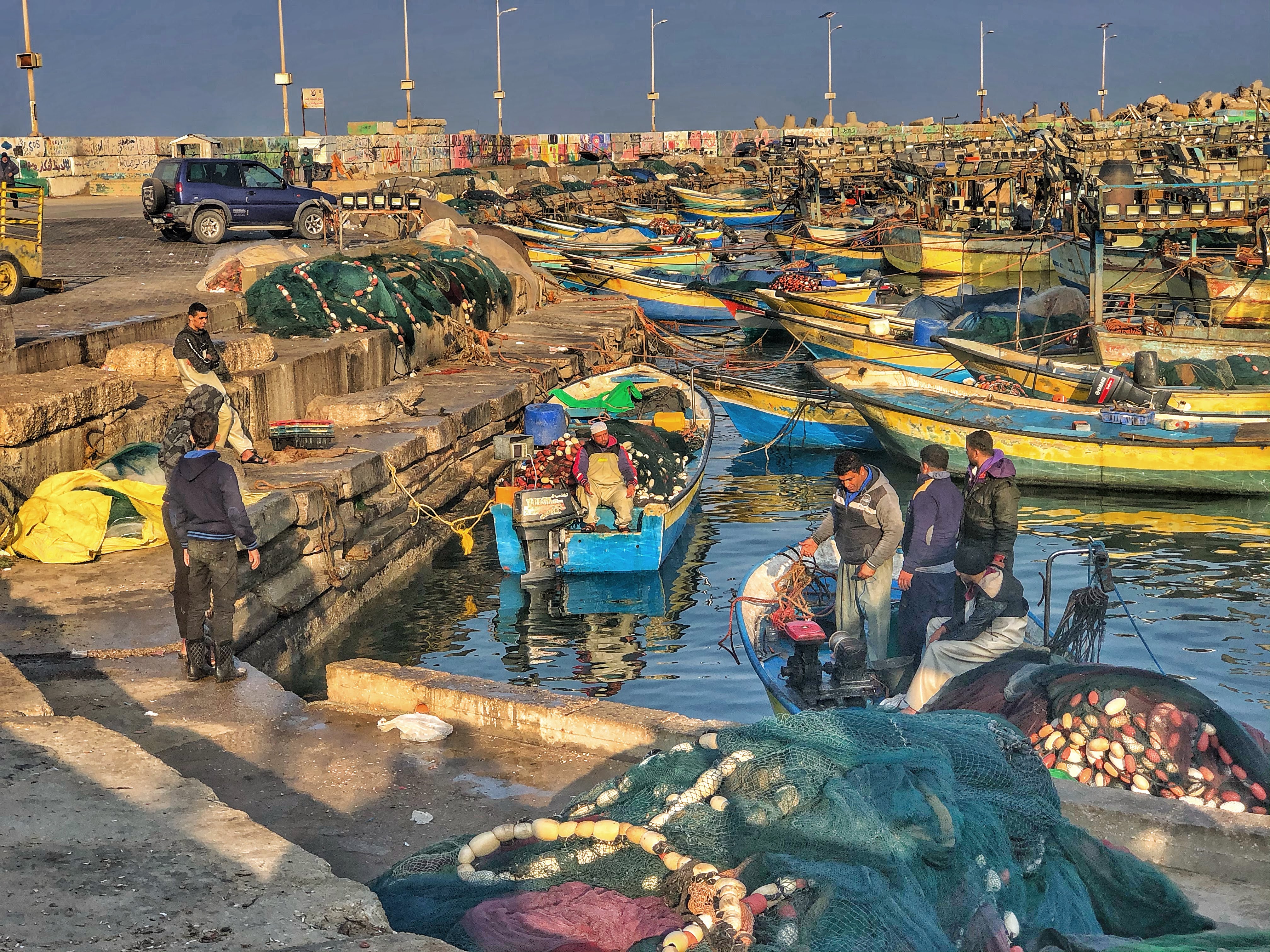
Before the siege, before the bombs, the sea fed people. Gaza's fishermen once pulled thousands of tons from the Mediterranean each year. Protein. Wages. Proof of a life still worth living. Today, nearly every boat is gone. More than 200 fishermen have been killed. Those who remain go out knowing they may not come back. This is what is left of Gaza's sea.
THE REALITY
Four thousand fishermen. Forty kilometres of coast. Between 3,000 and 4,600 tons of fish per year, before October 2023, feeding a population that had almost nothing else.
Those are not impressive numbers. In most places, they barely register. In Gaza, under blockade, every local source of food is the difference between hunger and worse.
Today, the fishing industry runs at less than 10 percent of what it was. Between October 2023 and April 2024, production fell to 7.3 percent of 2022 levels according to FAO data. The sector lost $17.5 million in that window alone. The fish markets are rubble. The ice factories are gone. The storage units, the port, the wholesale centre: destroyed or severely damaged. UN and FAO estimates put the destruction of fishermen's assets at between 70 and 94 percent across all categories.
Gaza sources and Al-Mezan Center for Human Rights have counted at least 200 to 235 fishermen and associates killed since the war began, most in airstrikes on their homes. Another 40 were killed while fishing, sometimes less than 500 metres from shore. Some at 200. Not at sea. At the edge of the water.
The fishing zone, once 20 nautical miles under the Oslo Accords, has tightened dramatically since October 7, frequently dropping to 3 nautical miles or less, with periods of near-total closure. In early 2025, Gaza's waters were declared a no-go zone. Zakaria Bakr, head of the Fishermen's Committees, says the fishing area is effectively zero miles.
ONE FISHERMAN'S STORY
Khaled Habib owned a boat. Not large. Not new. His.
Israeli bombardment destroyed most of the boats in Gaza City's harbour over 15 months of war. Habib's boat went with them. So he found cork. He stuffed it into old refrigerator doors to keep them afloat, covered one side with wood, the other with plastic sheeting, and bent wire into a fishing cage. Balanced on this, he now fishes inside the small port. Outside, he says, Israeli boats will shoot.
The catch is small. It feeds his family.
He is not exceptional. Before the war, the sector had around a thousand motorised boats. Now fishermen balance on styrofoam boards and old appliance doors. Some dive with rudimentary equipment, though that limits what they can catch. Mahmoud Abu Mahadi, 27, from Al Shati Camp, lost his boat and now shares a single vessel with three others, splitting fuel, risk, and whatever the sea gives them. "When your boat is destroyed," he told The New Arab, "you do not need a death certificate. You are economically dead."
THE CATCH THAT NEVER REACHES MARKET
Before the war, a fisherman returning to port might bring in sardines, mullet, sea bream. Simple food. The kind that a family in Gaza City would fry in olive oil with cumin and lemon, or bake whole with garlic and herbs, or salt and dry for the weeks when nothing came in. Not elaborate. Just protein, fresh and affordable, that kept children fed.
A kilogram of fish once cost 20 to 25 shekels. Now it costs 300 to 400 shekels, roughly 80 to 100 dollars. Most families cannot come close to that price.
"We have noticed a clear deterioration in the nutritional status of pregnant women and children, particularly due to the lack of protein," said Dr Iman Al Saba, an obstetrician at Al Shifa Medical Complex. "Many women suffer from anaemia. With red meat scarce and expensive, fish has become essential for maintaining basic health."
What little reaches the market is snapped up immediately. In Deir al-Balah, frozen fish arrives through special coordination at extra cost, as a substitute for the local catch that no longer exists. Most families get by on dwindling humanitarian rations. The nutritional gap grows.
THE NAVY'S RULES
Israel cites security concerns as the basis for its maritime restrictions. Hamas has used sea routes for weapons transfers and carried out maritime attacks in the past, including before October 7. The Israeli navy frames access limits as necessary to prevent further infiltration. These are not invented justifications.
What the record also shows: the permitted zone has been cut from 20 nautical miles to 3, then to 800 metres, with extended periods of total closure. The OHCHR documented 28 attacks on fishermen between January and May 2025, killing 11 and wounding 34. Its conclusion was direct: the targeting of fishers and fishing infrastructure has contributed to the risk of famine.
Fishermen who are not killed are often detained. In early 2026 alone, the Israeli navy carried out at least 17 attacks against Gaza fishermen and arrested 65, according to Al-Mezan. More than 20 arrests have been recorded since the ceasefire began. Some detainees describe forced stripping, long holds without charge, and interrogations focused on political information rather than fishing activity.
One fisherman told The New Arab: "The ceasefire was only on paper."
WHAT YOU CAN DO
Support documentation and legal advocacy. Al-Mezan for Human Rights and Gisha document attacks, provide legal aid to detained fishermen, and pursue accountability under international law.
Pressure governments to enforce the ceasefire. The current agreement includes provisions for maritime access. Contact your government and international mediators and ask them to enforce what was agreed.
Support direct aid to fishing communities. The Fishermen's Committees and UNRWA are working to provide emergency assistance and livelihood support. Fishermen have specifically appealed for nets, ropes, fibreglass, and small engines.
Share their names. Share this newsletter. The more people know what is happening off Gaza's coast, the harder it becomes to pretend it is not.
FINAL WORD
The sea was the one border Gaza could not be fully sealed from. A horizon. Something beyond the walls.
Now even that is a cage. Fishermen go out on refrigerator doors. They search for fish that are no longer there. They return to children who no longer have fathers.
They will not stop. This is their livelihood, their identity, a trade passed down through generations. The question is only what we do while they keep going.
Support Gaza's most vulnerable through Yafa Relief.
Yafa Relief delivers humanitarian aid directly to families in Gaza. Every contribution funds food, medical support, and emergency relief for people with nowhere left to turn.
Donate at yafarelief.org