A Newsletter on Displacement, Survival, and the Search for Stability
The sun rises over Gaza, but for millions, it brings no comfort. Children wake in tents instead of bedrooms. Their parents face the same harsh reality that has defined life for nearly 90% of Gaza's residents since October 2023: displacement is no longer an isolated event but a continual descent into instability.
What was promised as a path to peace has become something else entirely. Despite a ceasefire agreement that took effect on October 10, 2025, ongoing killings continue. According to Gaza's health ministry, at least 556 Palestinians have been killed and 1,500 injured since the ceasefire began. The Gaza Government Media Office has documented over 1,450 ceasefire violations through air strikes, artillery shelling, and direct shootings.
A Never-Ending Cycle of Movement
From October 2023 to late 2025, approximately 1.9 million people have been forced from their homes, many repeatedly. Kamil, an emergency nurse with Doctors Without Borders, and his colleague Haider have been displaced eighteen times. Their experience reflects a wider pattern: waves of military action and displacement orders have repeatedly uprooted civilians throughout the conflict.
Phase Two of the ceasefire agreement, meant to include Israeli withdrawal and transition toward permanent peace, remains elusive. Disputes over Hamas disarmament and the return of hostage remains have stalled progress, leaving families trapped between promises of reconstruction and the reality of continued displacement.
Living in Catastrophic Conditions
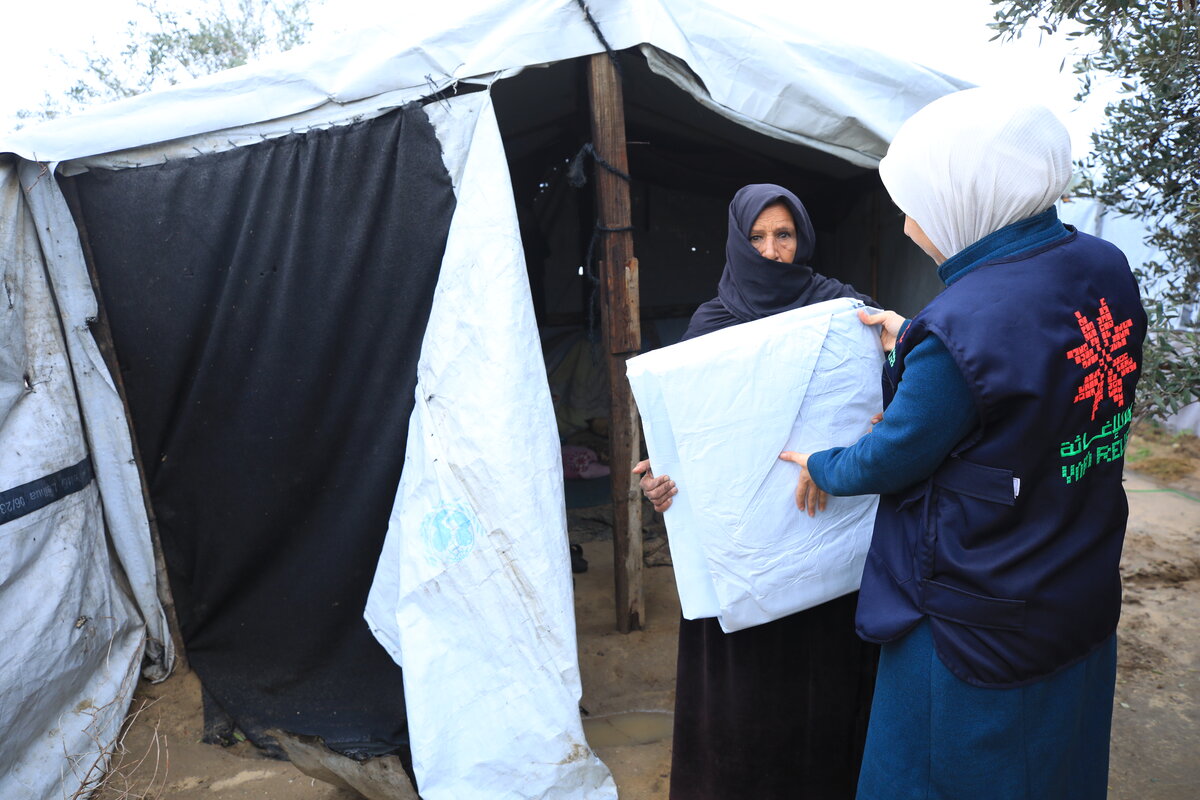
Families shelter in flimsy tents that offer little protection from winter rains or summer heat. Heavy rains and poor drainage have caused widespread flooding in displacement sites. At least 795,000 displaced people in unsafe shelters face severe flood risk, and emergency supplies like sandbags and water pumps remain blocked from entry.
Key humanitarian agencies like UNRWA have struggled to bring in food, medicine, and essential supplies. Despite the ceasefire stipulation that full aid would be immediately sent into Gaza, only 28,927 trucks entered from October 10, 2025 to January 31, 2026. This is just 43% of the allocated amount, averaging 260 trucks per day instead of the promised 600. Israeli inspections cause significant delays, and essential nutritious foods including meat, dairy, and vegetables have been blocked.
The Rafah Crossing, briefly reopened under the ceasefire agreement for medical evacuations, offers only limited relief. A fraction of those needing urgent care can receive safe passage, and some have died while waiting.
More than 1.6 million people still face high levels of acute food insecurity. Water scarcity and collapsed sanitation remain chronic stressors. Before the conflict, half a million children were enrolled in UN-run schools. Today, schooling is interrupted or improvised in overcrowded shelters.
A Contested Path Forward
The ceasefire has allowed some prisoner exchanges. All 20 remaining living Israeli captives were released in exchange for 250 Palestinians serving long sentences and 1,700 Palestinians detained since October 7, 2023.
The National Committee for the Administration of Gaza (NCAG), a technocratic committee of 15 independent Palestinian professionals led by Ali Shaath, represents an attempt at transitional governance. Announced in January 2026 and authorized by UN Security Council Resolution 2803, the NCAG is tasked with restoring basic services and managing reconstruction under the supervision of the Board of Peace (BoP), chaired by U.S. President Donald Trump.
However, the committee faces enormous challenges. It has been blocked from entering Gaza, lacks political authority, and operates under oversight that includes staunchly pro-Israel figures. The NCAG is explicitly limited to civilian affairs, meaning Hamas will continue to retain de facto security control.
An International Stabilization Force (ISF), authorized to coordinate border management with Israel and Egypt, is meant to provide security oversight. Yet questions remain about how such a force can operate effectively when ceasefire violations continue almost daily and rubble clearance has barely begun.
The Human Cost
Humanitarian workers, including over 1,600 staff and volunteers with local and international aid organizations, continue to provide life-saving support. Thirty-one Palestine Red Crescent Society colleagues have been killed since 2023, including eight medics killed in a single incident in March 2025.
The statistics point to a human catastrophe that is about people's futures, not just their present survival. The ceasefire, meant to be a pathway to peace, has instead become another chapter in a long story of broken promises. What is needed most is sustained global attention and concerted advocacy for a just, lasting peace that finally allows families to stop running and start living again.