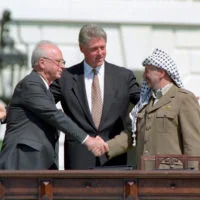
The handshake lasted four seconds.
Yasser Arafat and Yitzhak Rabin, on the White House lawn, in September 1993, with Bill Clinton's arms spread wide behind them like a man trying to hold two things together that did not naturally stay together. The photographs went around the world. The Nobel Peace Prize followed the next year. The commentators said history had turned a corner.
Thirty-three years later, the corner has not been turned. The interim arrangements signed that day are still in force. The Palestinian state that Oslo was supposed to deliver does not exist.
What the Document Actually Said
The Declaration of Principles, the formal name of the Oslo Accords, was not vague about its timeline. Article I stated the goal plainly: to establish a Palestinian Interim Self-Government Authority for a transitional period not exceeding five years, leading to a permanent settlement. Article V required permanent-status negotiations to begin no later than the third year of that interim period. The issues to be resolved were listed by name: Jerusalem, refugees, settlements, borders, security arrangements.
Five years. Listed by name. Binding timetable.
The five-year clock started with the 1994 Gaza-Jericho withdrawal. It expired in May 1999. No permanent agreement was reached. No binding deadline followed. The interim arrangements simply continued, as if the clock had never run out, as if the document had never existed, as if a generation of Palestinians had not reorganised their lives around what those pages promised.
What Was Built While the Talks Stalled
Here is the thing about deferring settlements to final-status talks: every year of deferral, more settlements were built.
Oslo contained no requirement to freeze settlement construction during the interim period. The settlers were already there. The document listed settlements as a final-status issue, which meant they were not to be touched until a permanent agreement was reached, which meant they could grow freely while the talks continued, which meant that by the time the talks were supposed to conclude, the facts on the ground had fundamentally changed what any agreement could look like.
In 1993, roughly 110,000 settlers lived in the West Bank. Today, according to Peace Now and Israeli government data, that number exceeds 500,000 in the West Bank alone, with a further 230,000 in East Jerusalem. The settler population has more than quadrupled since the handshake on the White House lawn. This did not happen by accident. It happened because Oslo created a framework with no enforcement mechanism and no settlement freeze, inside which settlement expansion was entirely legal.
Think of it this way: a property dispute goes to mediation, but one party is allowed to keep building on the disputed land throughout the entire mediation process. By the time the mediators reach a conclusion, there is nothing left to mediate.
The Authority Without a Mandate
Oslo also created the Palestinian Authority, the governing body that was supposed to administer Palestinian affairs during the interim period and then, once permanent status was agreed, govern a Palestinian state.
The PA has governed the West Bank since 1994. Mahmoud Abbas was elected president in January 2005 for a four-year term. That term expired in January 2009. No presidential election has been held since. The Palestinian Legislative Council last voted in 2006, also for a four-year term. No legislative election has been held since. The Palestinian Center for Policy and Survey Research found in 2008 that nearly two-thirds of Palestinians believed Abbas's mandate had already expired.
The institution that Oslo built to govern a transitional period has been governing, without a fresh mandate, for fifteen years past its expiry. The transitional period it was built for has lasted thirty-three years. Nobody has a plan to end it.
What the Structure Was Designed to Do
Oslo was not a peace agreement. It was a framework for reaching one. The distinction matters. A peace agreement has terms, borders, and enforcement. A framework has principles, a process, and good intentions. Oslo contained no enforcement mechanism if permanent-status talks failed. It contained no penalty for settlement expansion. It contained no guarantee that the five-year interim would end.
As historian Rashid Khalidi has argued in "The Hundred Years' War on Palestine," Oslo formalised an asymmetric bargain: Palestinian recognition of Israel in exchange for Israeli recognition of the PLO, without a parallel Israeli commitment to a Palestinian state. The PLO gave up its primary legal card, recognition, before the permanent-status issues were resolved. After that, the incentive to resolve them diminished considerably.
This is what the text shows. No binding timetable for a final deal. No settlement freeze. No enforcement. Oslo did not fail by accident. It was structured in a way that made the current situation, thirty-three years of interim arrangements, over half a million settlers, a governing authority without a mandate, and no Palestinian state, not just possible but predictable.
The Corner Not Turned
What followed that four-second handshake has lasted longer than anyone on that lawn admitted was possible: repeated full-scale military campaigns in Gaza, including major operations in 2008-09, 2012, 2014, 2021, and the devastating war since October 2023; a settler population that has more than quadrupled; a governing authority still operating on a mandate that expired in 2009; and the core issues of borders, refugees, Jerusalem, and settlements still unresolved, still deferred, still listed in a document signed in Washington in 1993 as things that would be settled within five years.
The interim is still running.
The five years are still not over.