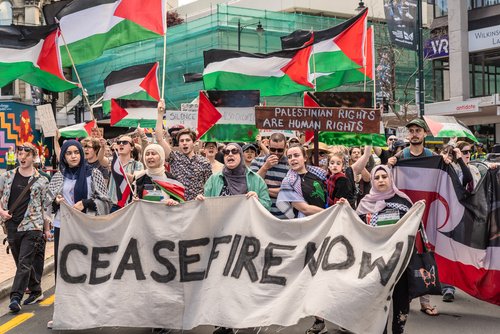
How the Iran conflict became Gaza's second siege
Editor's note: On February 28, the United States and Israel launched large-scale strikes on Iran. Missiles. Counter-missiles. A closed strait. The world called it a "fragile ceasefire" by April 8. Extended indefinitely. No set deadline. But in Gaza, no one stopped counting.
The ceasefire did not pause Gaza. It redirected the world's attention away from it.
According to the Armed Conflict Location and Event Data Project, Israeli attacks on Gaza rose by 35% in April compared to March, the month the Iran war started. The Gaza Health Ministry, per Al Jazeera, recorded 120 Palestinians killed, including eight women and thirteen children, in the five weeks after April 8 alone. That is a 20% increase over the period when Israel was also bombing Iran.
"The war is still ongoing," Lafi al-Najjar told Reuters. He is blind. His son was killed in an Israeli strike on April 28. "It stopped in the announcement, but in reality and on the ground, the war has not stopped."
Since the October 2025 ceasefire, approximately 850 Palestinians have been killed in Israeli strikes, per Gaza Health Ministry aggregates. Four Israeli soldiers were killed by Palestinian armed groups in the same period. Israeli forces now occupy more than half of Gaza's territory. Buildings are being demolished. Residents are being ordered out. More than two million people live on a narrow coastal strip, in damaged structures or tents.
This is not a pause. It is the world choosing to look elsewhere.
THREE FRONTS, NO EXIT
Gaza does not exist in isolation. It is one corner of a war that keeps finding new rooms.
Lebanon. On March 2, Hezbollah opened a second front, firing rockets into Israel. On May 17 alone, Israel struck 100 sites in southern Lebanon over two days, despite a separate ceasefire extension agreed in Washington. At least 21 Israeli soldiers have been killed in Lebanon. Hezbollah, far from broken, responded to each Israeli violation with drones, mortars, and rockets.
Iran. The April 8 ceasefire, brokered by Pakistan, has not held. Israeli Defense Minister Israel Katz stated that Israel is "prepared for the possibility that we may soon be required to act again in Iran." Senior military officials have held talks with US Central Command about resuming operations. Iran, for its part, has announced plans to charge tolls on the Strait of Hormuz. Oil prices are watching.
Gaza. The IDF's Southern Command has developed a plan to resume large-scale fighting, with evacuation measures and new "humanitarian zones," according to Walla. A senior security source told the outlet that the collapse of the Gaza ceasefire depends directly on developments with Iran. Gaza, in other words, is a bargaining chip. Traded between men who need the war to continue.
THE POLITICS OF PERPETUAL WAR
Benjamin Netanyahu faces a general election in six months. Israeli political analysts have assessed that he is using external escalation to escape internal dilemmas, whether in Gaza, Lebanon, or Iran. His coalition has staked itself to dismantling Iran's nuclear program. Anything short of that looks like defeat.
Donald Trump wants the war over before the World Cup. His generals cannot promise what they could not deliver in six weeks of fighting. The nuclear question remains open. The strait remains contested.
Neither man has an exit strategy. Both have reasons to keep the fire burning.
WHAT CHANGED, AND WHAT DIDN'T
The war with Iran has not achieved what it set out to do. No regime change in Tehran. Iran's nuclear program intact. Its missile and drone production capacity not only survived but expanded, with subterranean factories working around the clock while Israeli and US supply chains lag behind.
What did change: Gaza has been erased. Lebanon is burning. Tens of thousands of Israelis remain displaced from the northern border, unable to return home.
The European Council on Foreign Relations writes that the war is "quite unlikely to end anytime soon." The framework for resolution does not exist. Hamas refuses to disarm without a political pathway to statehood. Israel refuses to withdraw without disarmament. The United States, consumed by Iran, has abandoned its role as mediator.
On paper, ceasefires exist. On the ground, bombs fall.
WHAT THIS MEANS
Since the Iran war began, aid trucks entering Gaza declined by 80%. The price of basic goods has skyrocketed. The humanitarian crisis has not deepened slowly. It has collapsed.
There is no political solution being built. Not now. Not soon.
The world has moved on to Iran. The aircraft carriers have returned home. Diplomats shuttle between capitals. But in Gaza, a blind father buried his son. In Lebanon, villages are being emptied. In the Strait of Hormuz, oil tankers wait for permission to move.
The war did not end. It just found new shareholders.
HELP US KEEP TELLING THESE STORIES
Yafa Relief delivers humanitarian aid and funds emergency relief directly to families in Gaza. Every newsletter we publish, every dispatch we send, is backed by people who refuse to look away.
If this dispatch reached you and you are in a position to give, please consider donating at yafarelief.org. No amount is small. The people of Gaza do not need sympathy. They need food, medicine, and people willing to act.
Donate at yafarelief.org