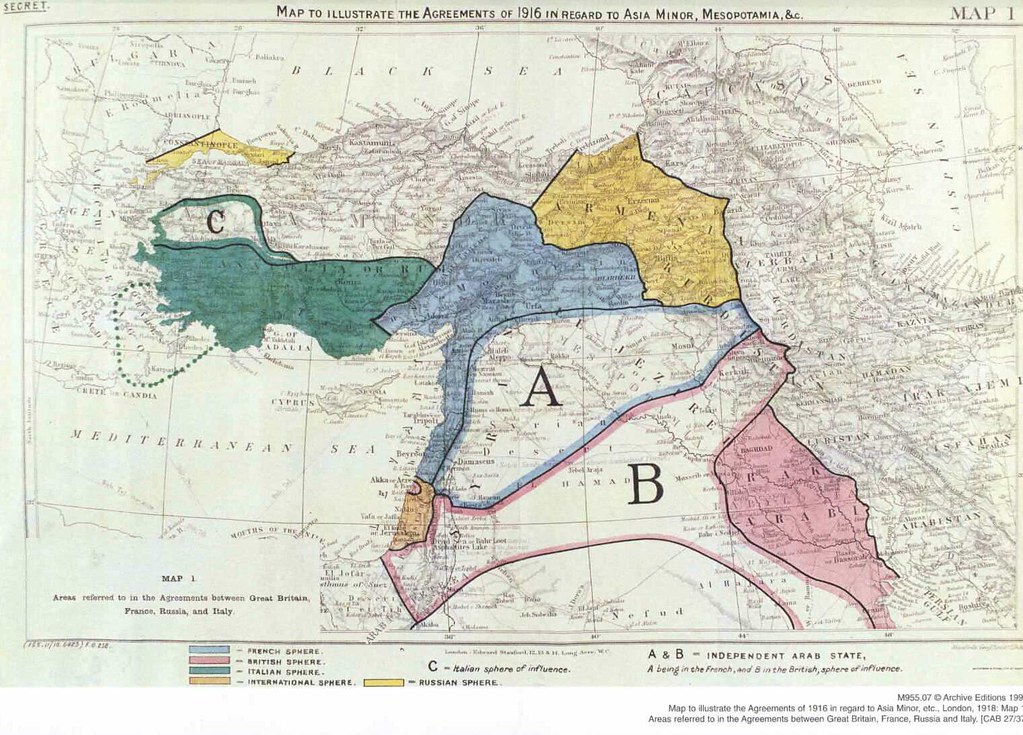
Three promises. One piece of land. All of them made within eighteen months of each other, all of them kept secret from the other parties, none of them compatible.
This is where it starts. Not in 1948. Not in 1967. Not in Oslo. In a set of letters and agreements produced between 1915 and 1917 by British officials who were fighting a world war and needed allies, and who offered the same territory to different people to get them.
The First Promise
In October 1915, Sir Henry McMahon, British High Commissioner in Egypt, wrote to Sharif Hussein of Mecca. Britain needed the Arabs to rise against the Ottoman Empire. The price was independence.
McMahon's letter stated that Britain was "prepared to recognize and support the independence of the Arabs" within boundaries that, by any reasonable reading of the geography, included Palestine. Hussein understood it that way. His forces rose. They fought alongside British troops across the Arabian Peninsula and into what is now Jordan and Syria, on the basis of what those letters said.
Britain later claimed the language was ambiguous. Palestinian and Arab historians have always disputed this. A 1939 British government committee, reviewing the correspondence internally, acknowledged that the commitment "looks like" it covered Palestine.
It looked that way because it did.
The Second Promise
While McMahon was writing to Hussein, British and French diplomats were drawing lines on a different map.
The Sykes-Picot Agreement of May 1916 was a secret deal between Britain and France to divide the Ottoman Arab provinces between themselves after the war. Palestine, in that agreement, was placed under "international administration," with Britain controlling the ports of Haifa and Acre. France would take northern Galilee.
The Arabs fighting alongside British forces did not know this agreement existed. They found out in 1917, when the Bolsheviks, after seizing power in Russia, published the secret treaties they found in the Tsar's files. The reaction among Arab leaders was exactly what you would expect when someone discovers that their ally has been secretly parcelling out the land they were promised.
The Third Promise
Two November 1917. Foreign Secretary Arthur James Balfour wrote a letter to Lord Rothschild, a leader of the British Jewish community, on behalf of the government.
"His Majesty's Government view with favour the establishment in Palestine of a national home for the Jewish people," the letter said, "and will use their best endeavours to facilitate the achievement of this object, it being clearly understood that nothing shall be done which may prejudice the civil and religious rights of existing non-Jewish communities in Palestine."
Thirty-seven words in. Then a qualifier about the rights of "existing non-Jewish communities," which is how the Balfour Declaration referred to the Arab population that made up roughly 90 percent of Palestine at the time.
Three promises. The Arabs had been promised independence. France and Britain had secretly agreed to divide the territory. Now the Zionist movement had been promised a national home. All three commitments concerned the same land. None of the parties knew about the others.
What the Mandate Did With This
In 1920, Britain received the League of Nations Mandate to govern Palestine. The Mandate's preamble incorporated the Balfour Declaration verbatim, turning it into international legal obligation. Article 2 made Britain responsible for establishing the conditions that would "secure the establishment of the Jewish national home."
The McMahon correspondence was not in the preamble. The Arab independence pledge was not in the Mandate. Of the three promises Britain had made, the Mandate enshrined one and buried the other two.
For twenty-eight years, from 1920 to 1948, Britain administered a territory in which it was legally obligated to facilitate a Jewish national home while governing a majority Arab population that had been promised something incompatible. The 1936 Arab Revolt. The Peel Commission's partition proposal. The 1939 White Paper attempting to limit Jewish immigration. The violence between Jewish and Arab communities throughout the 1940s. Every crisis of the Mandate period grew from the same root: two irreconcilable commitments, made in wartime secrecy, locked into a governing document that chose one and ignored the other.
Tom Segev, in "One Palestine, Complete," his definitive history of the Mandate, shows how British administrators on the ground knew from early on that the arrangement was unworkable. They wrote memos saying so. London read the memos and continued.
What Was Constructed at a Desk
Here is the thing your history teachers probably skipped: the conflict over Palestine was not the inevitable product of ancient hatreds or incompatible religions. It was the product of specific decisions made by specific officials in London and Paris between 1915 and 1917, under the pressure of a world war, with full awareness that the promises being made could not all be kept.
Jonathan Schneer, in "The Balfour Declaration," documents how British officials at the time recognised the contradiction. They made the promises anyway, because each one solved an immediate wartime problem, and the long-term incompatibility was someone else's problem to manage.
It became everyone else's problem. It still is.
The Shadow
This piece is the first chapter of a trilogy your archive has been building without knowing it. Your Nakba newsletter showed what happened in 1948 when the Mandate ended and the contradictions finally became war. Your Oslo newsletter showed what happened in 1993 when a framework tried to resolve what the Mandate had created and structured the failure into the solution.
This is what came before both. The desk in London. The three promises. The one Mandate that chose between them.
The shadow cast by those decisions in 1917 is still falling.