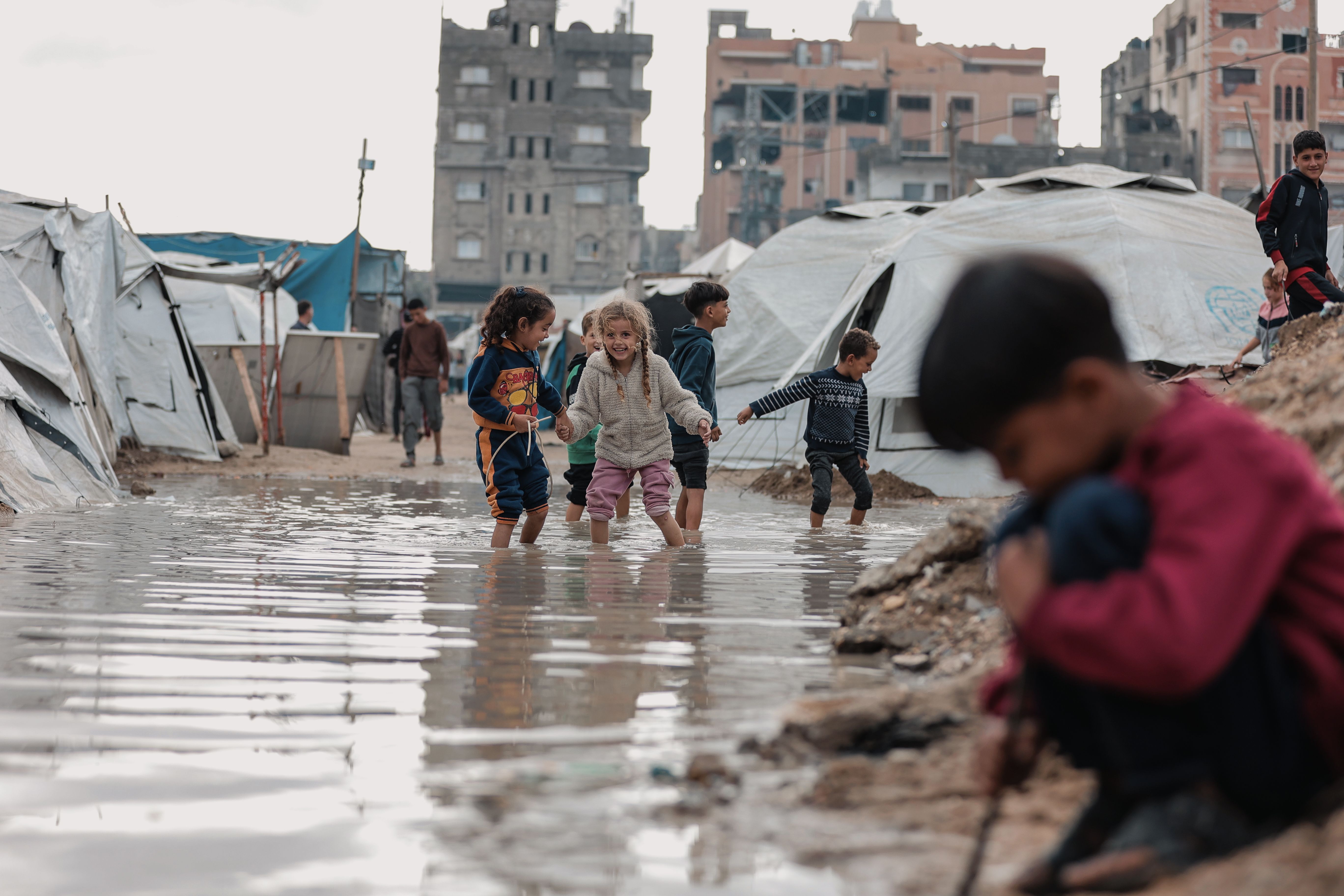
Before October 2023, Gaza had nearly 100 registered bakeries. Today, a handful remain. The rest are rubble, or dark, or simply out of flour.
This is a story about bread. About the people who make it, the people who wait for it, and what happens to a city when it runs out.
Before Dawn
Mohammad Abu Tair arrives at the metal doors while they are still shut. He has been doing this since six in the morning, every morning. The queue behind him keeps growing.
His family used to bake their own bread. They cannot now. Since border closures in March, no commercial wheat flour entered Gaza for weeks. A 25-kilogram bag that once cost 20 shekels sells, when you can find it, for over 500. Abu Tair does not have a job. He cannot afford it.
So he waits. One bundle of bread, 21 loaves. His family is nine people.
Built From What Was Left
Tariq Ewaida’s Haifa bakery in Khan Younis was hit by an airstrike in July 2025. His father, the previous owner, went to see the damage. He did not come back. His nephew died beside him.
Ewaida rebuilt anyway. The bakery sits a few hundred meters from the yellow line, the boundary marking where Israeli forces control the territory. Customers sometimes wait until after sunrise because walking in the dark means walking toward the sound of shootings.
“Nothing you see here is new,” Ewaida said. “It’s all been repaired.”
The ovens run on salvaged parts. Spare parts that once cost 5,000 shekels now cost over 40,000. Mohammed Zidan, who runs the Castle bakery in Deir al-Balah through a WFP diesel-supply program, says his machines have not had proper servicing in three years. He describes them as tired.
He keeps baking.
“Every bakery in Gaza can support around 100 people and their families,” Zidan said, “across supply, transport, production, security, and sales. It helps keep the local economy going.”
The Math
In early March, WFP-supported bakeries sold a bundle of 21 loaves for two to three shekels, under one US dollar. The crossings were open. Production was running.
Then the crossings closed.
By May, only five of 23 WFP-contracted bakeries were still operating. Food stocks inside shops had dropped to four or five days’ supply. World Central Kitchen, which had served over 272 million meals and 73 million loaves of bread across its Gaza operations, announced in June 2026 that it was halting operations entirely. It had no supplies left to cook meals or bake bread. The border had been closed since March. Nothing was coming through.
WFP’s Middle East spokeswoman Abeer Etefa put it plainly: “The situation in Gaza is getting worse by the minute.”
What Hunger Looks Like
A woman at a hot meal kitchen found only soup. She took home a pot containing 16 beans for a family of five.
A small boy sold his last toy to buy a piece of bread.
These are not metaphors. They are what WFP staff reported from the ground.
“No bread, no Gaza,” one resident said.
What Keeps the Ovens On
It is not certainty. It is not a steady supply chain. In most cases, it is one person who decided to rebuild and has not stopped.
Zidan still sources his own raw materials, navigating market prices warped by restriction. He patches machines that should have been replaced years ago. He opens every morning.
“What we do,” he said, “is make sure people have bread to eat.”
That sentence carries more weight than it should have to.
What You Can Do
Yafa Relief works directly in the supply chains that keep Palestinian families fed, including support for food access projects inside Gaza. Every donation funds real, traceable work.
If you can give, give now. The bakeries that are still running need flour. The families still queueing before dawn need that flour to reach them.
Donate at yafarelief.org
If you cannot give right now, share this newsletter. Pressure matters too. Write to your government. Ask, loudly, why humanitarian crossings are still closed. Bread is not a political position. It is the thing a boy sold his last toy to buy.
The queue forms before dawn, every morning, in front of metal doors that may or may not open.
Somewhere in that queue is a family of nine with one bundle between them.
They are still counting on the ovens to stay on.
Sources: World Food Programme field reporting, World Central Kitchen operational updates, June 2026.
I’ll create both versions now, working from the English newsletter with all editorial rules preserved.
The user just wants translated text, not a docx file. I’ll produce both translations directly as clean text output.