The olive harvest of 2025 was the worst in decades.
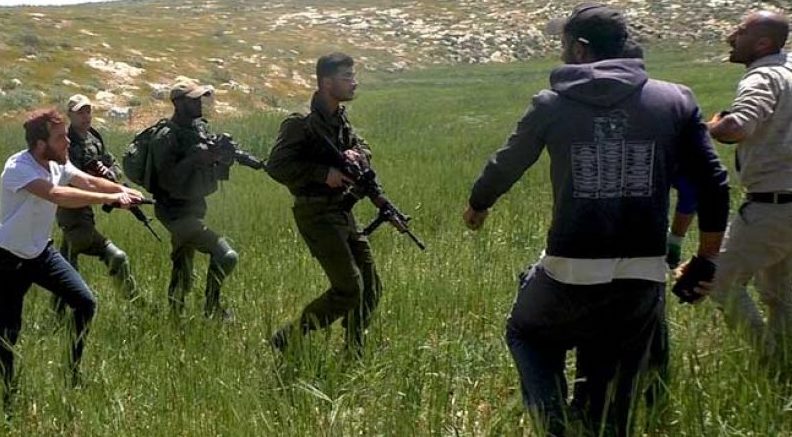
Not because of drought. Not because the trees failed. Because armed settlers arrived at the groves and the farmers could not get to their land. October 2025: forty-two settler attacks in a single month, leaving 131 Palestinians injured, including fourteen women and a boy. The UN Human Rights Office called it the highest number recorded in a single month since 2006. The olives stayed on the trees. The families went home without them.
This is the story that gets crowded out. Gaza takes the headlines, the aid convoys, the diplomatic statements, the grief. The West Bank takes what's left: a slower, quieter process of displacement that the UN is now calling what it is.
The Numbers the World Is Not Watching
In January 2026, settler violence displaced 694 Palestinians in the occupied West Bank. The highest monthly figure since October 2023. Six hundred of those came from a single community: Ras Ein al-Auja, a herding village in the Jordan Valley where 130 families had been enduring months of sustained settler harassment. By January they were gone, marking what OCHA described as the highest single-community displacement due to settler attacks and access restrictions in three years.
That was one month.
The UN Human Rights Office report covering the twelve months up to October 2025 documented 1,732 incidents of settler violence resulting in casualties or property damage. The previous reporting period had recorded 1,400. The direction of travel is not ambiguous. Neither is the conclusion the report reaches: "Settler violence continued in a coordinated, strategic and largely unchallenged manner, with Israeli authorities playing the central role in directing, participating in or enabling this conduct."
Not passive bystanders. Central role. Those are the UN's words, not an advocacy group's.
How It Works
The mechanism is not always dramatic. It rarely needs to be.
Settlers move livestock onto agricultural land used by Palestinian communities, gradually denying access. They destroy olive groves, the economic foundation of villages that have farmed the same hills for generations. They enter at night. They burn. They intimidate. They return the next week and the week after, until the calculation shifts and a family decides that staying is no longer survivable.
Israeli military forces are frequently present. Frequently not intervening. The OHCHR report describes "settler soldiers," people who hold both roles simultaneously, armed and equipped by state authorities. The line between state violence and settler violence has, the report concludes, become impossible to draw.
When the violence is documented and reported, prosecution rarely follows. Impunity is not a failure of the system. It is the system. The UN report is plain about this: longstanding impunity is "facilitating and encouraging violence against and harassment of Palestinians."
In some cases, the final trigger for a family leaving is gender-based violence. Women and children are driven out first. Men sometimes stay behind, trying to hold the land, separated from their families, alone on property that settlers have marked as a target.
What Is Being Built
While families leave, construction continues.
During the same twelve-month period documented by OHCHR, Israeli authorities approved or advanced 36,973 housing units in settlements in occupied East Jerusalem and approximately 27,200 more in the rest of the West Bank. Eighty-four new outposts were established, an unprecedented figure for a single year. Settlement activity has expanded into Area B, the part of the West Bank that falls under Palestinian Authority jurisdiction according to the Oslo Accords.
You read that correctly. Settlement expansion into the territory that Oslo assigned to Palestinian governance.
Over 36,000 Palestinians were forcibly displaced during this period, according to OHCHR. Human Rights Watch, in its 2025 report titled "All My Dreams Have Been Erased," documented the lived reality behind that figure: families forced from homes they have lived in for generations, farmers cut off from land their grandparents cultivated, communities that no longer exist where they once stood.
What the Law Says
The Fourth Geneva Convention is unambiguous. The forcible transfer of protected people under occupation is a war crime. The OHCHR report notes that such acts "potentially incur the individual criminal responsibility of officials engaged in them, and under certain circumstances, may also amount to a crime against humanity."
The report goes further. The combination of settlement expansion, land confiscation, forced eviction, and "discriminatory policies and practices" amounts, it concludes, to an "institutionalised regime of systematic discrimination, oppression and violence by Israel against Palestinians," violating the international law prohibition of racial segregation and apartheid.
These are not the words of a solidarity organisation. They are the words of the United Nations High Commissioner for Human Rights, in a report published in March 2026.
The Quiet Emptying
Allegra Pacheco, director of the West Bank Protection Consortium, a group of NGOs working to support Palestinian communities against displacement, said it plainly to AFP in February: "All eyes are focused on Gaza when it comes to Palestine, while we have an ongoing ethnic cleansing in the West Bank and nobody's paying attention."
She used the phrase the OHCHR report approaches but stops just short of: ethnic cleansing. The report uses "concerted Israeli policy of mass forcible transfer aimed at permanent displacement, raising concerns of ethnic cleansing." The gap between those two formulations is narrower than it might seem.
The olive trees are still there. The families who tended them are not.
That is the story. It is happening now, in the part of Palestine that the world has decided is the quieter one.
It is not quiet.